Bill David
Black Hawk DownBill David was the ground commander charged with assembling and leading a second rescue force into Mogadishu after the first attempt had been beaten back. His part in the battle is defined by the pressure to move before wounded Rangers died, and by the difficult work of turning a multinational collection of troops and vehicles into a usable convoy. The force finally left the gate at 11:20 p.m.; as it approached the Black Sea neighborhood, it met fresh ambushes.
Command Under Urgency
David understood what delay meant: wounded Rangers still in the city could die if the rescue convoy did not reach them soon. More than five hours into the battle, however, urgency could not by itself make a force ready to move. As ground commander of the Quick Reaction Force, he faced a large assembly task late in the evening, with vehicles and personnel from several contingents to coordinate.
The need for a second attempt followed an earlier failed drive. Before sunset, David and Charlie Company had tried to reach the southern crash site, where Mike Durant and his crew faced the danger of being overrun. The convoy got only as far as K-4 Circle, more than a mile from the site, before a heavy ambush forced it to turn back. The renewed operation therefore began with a starkly practical problem: the rescue force had to return to the city despite the evidence that the route was defended and the previous column had not reached its objective.
Assembling the Force
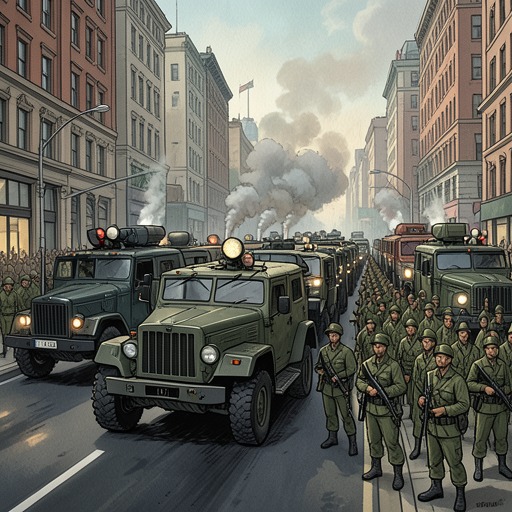
David was ordered to put together a much larger force from several distinct elements: four Pakistani tanks, 28 Malaysian armored personnel carriers, his own men, 150 soldiers from Alpha Company, a platoon of Ranger volunteers, and the ambulatory remnants of the lost convoy. The assembly took place at the New Port facility, a few miles up the coast from Task Force Ranger's base. The Rangers and the other soldiers were eager to get moving, but assembling the vehicles, troops, and command arrangements was not a simple matter of forming a column.
Communication complicated the preparations. Most Malaysian and Pakistani commanders spoke English, but their men did not, so decisions took longer to carry out. Soldiers gathered around David and held flashlights over his map as he worked through the plan. He had to explain to the Malaysian commanders that their vehicles were needed, but their men were not: he intended to put his own better-trained soldiers aboard the armored personnel carriers rather than send the Malaysian crews forward with them. The distinction was part of a specific deployment plan, not a general rejection of the allied contingent's contribution.
The Plan and Its Compromise
David's proposed arrangement assigned different tasks to different parts of the force. He wanted to load his own soldiers onto the Malaysian armored personnel carriers, place the Pakistani tanks at the head of the column, advance to a point between the two crash sites, and then dispatch one company to each site. The plan linked the two rescue objectives while recognizing that separate groups would have to move from the convoy's central position toward the crash locations.
A late objection altered the formation. At 11:20 p.m., after the delays, the force was finally ready to leave the gate when the Pakistani leader sprinted to David's Humvee with the news that his unit had been ordered not to lead the convoy. David negotiated a compromise rather than abandon the tanks' part in the operation: they would escort the column for the first few miles, where they could help it through ambushes or roadblocks, then withdraw and allow Alpha Company to take the lead in the armored personnel carriers. The solution preserved an initial role for the tanks while accommodating the Pakistani order.
Departure and Immediate Stakes
The convoy moved out in the planned formation. Its departure was the culmination of hours of urgent coordination, but not the end of the danger or uncertainty. As the force neared the Black Sea neighborhood, a stronghold of Mohamed Farrah Aidid, Somali fighters launched vicious ambushes. The account leaves David at the point where the newly assembled column enters this threat: it records the plan, the compromise that made departure possible, and the renewed fighting, without establishing here whether his intended division of the force reached either crash site.
David's episode also shows how command under fire depended on information and coordination as much as on numbers. He had to organize a force combining tanks, armored personnel carriers, trucks, and soldiers from different contingents, while translating a map-based plan into instructions that could be executed across language and command barriers. His response to the dispute over the lead position was a practical adjustment to the formation, made under a deadline measured against the lives of wounded men still in Mogadishu.